Pain Charts Showing Most Sensitive Place to Tattoo
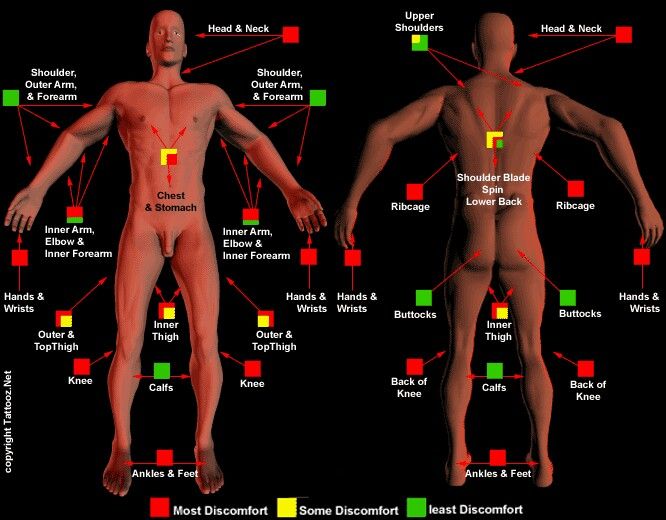
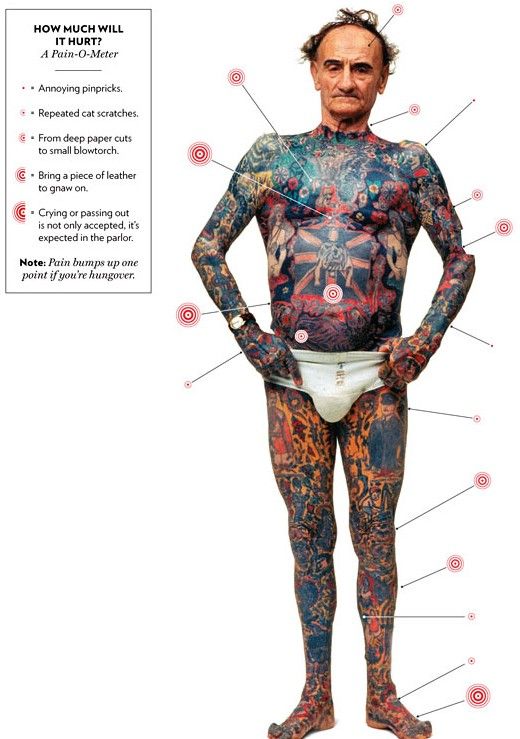
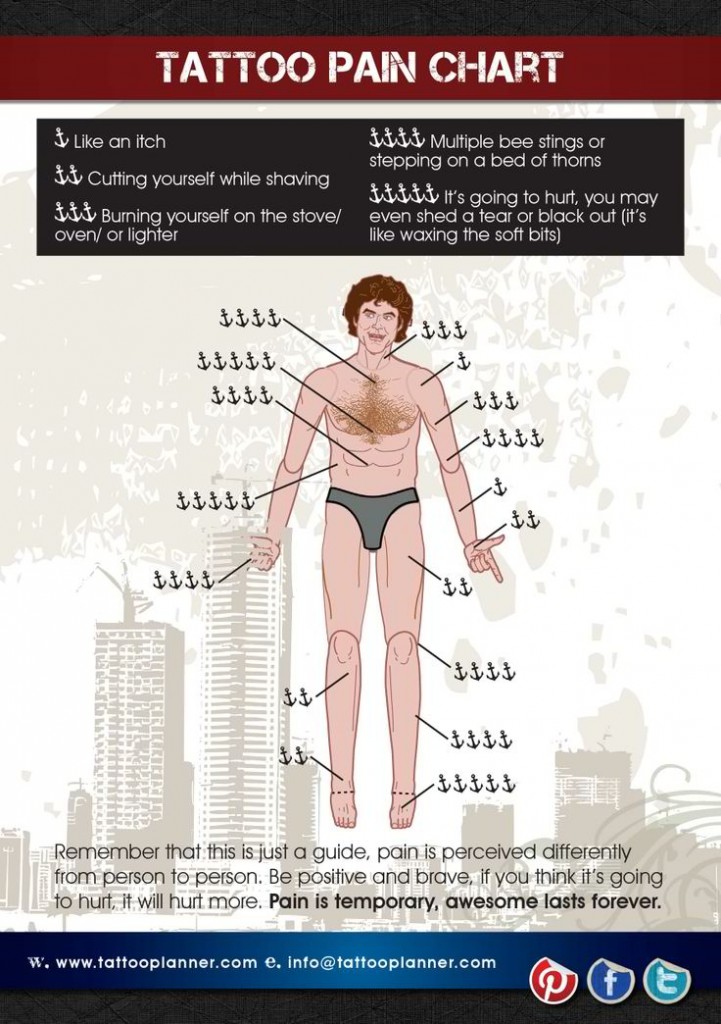
Every pain chart you will find, including the ones below, is an average of other people's nervous systems. Yours will disagree somewhere. What the charts get right is the pattern, and the pattern is anatomical: the needle hurts more where there is little between skin and bone, where nerve endings are dense, and where the skin is thin or rarely exposed.
Worth saying plainly before the charts: pain is the part of a tattoo people worry about most and regret least. It is finite, it is survivable, and it is never the reason to talk yourself out of the right design or the right artist.
Why placement changes everything
Three things drive how much a spot hurts.
Fat and muscle between skin and bone. Outer arm, thigh and calf have a layer to absorb the vibration. Shin, sternum, ankle and elbow do not, and the sensation travels into the bone.
Nerve density. Hands, feet, the inner wrist, the neck and the ribs carry far more nerve endings per square inch than the outer arm.
Skin thickness and how often it sees daylight. Inner bicep, inner thigh and the underside of the forearm are thin, soft and unused to friction, which is exactly why they are sharp.
Add a fourth that has nothing to do with anatomy: how long you have been sitting. Hour one on the ribs is manageable. Hour four is a different proposition entirely, and endurance is what actually ends most sessions.
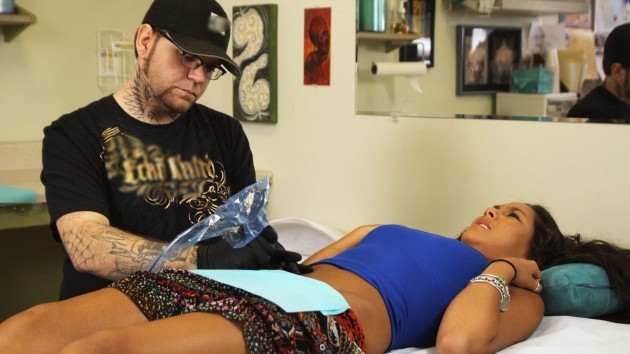
What it actually feels like
Not one sensation but four, and knowing which is coming helps more than a number does.
- Scratching - the common one, like a cat dragging a claw over sunburn. Outer arm, thigh, calf.
- Burning - a hot, dull ache that builds when the artist works one area for a long stretch. Anywhere, once the session runs long.
- Vibrating - a deep buzz where the needle is close to bone. Shin, elbow, ankle, sternum, the top of the foot.
- Sharp and stinging - thin skin over nerve-dense areas. Ribs, inner bicep, hands, feet, neck, sternum.
Colour packing and heavy shading hurt more than linework, because the same skin gets worked repeatedly. Many people find the outline the easiest part and are surprised by the shading.
Placement by pain
The figures are 1-10, an honest average rather than a promise, alongside how long most people can realistically sit before the session has to end.
| Placement | Pain | Sensation | Realistic sitting |
|---|---|---|---|
| Outer upper arm | 2-3 | Scratching | 4-6 hours |
| Outer thigh | 2-3 | Scratching | 4-6 hours |
| Forearm, outer | 3-4 | Scratching | 4-5 hours |
| Calf | 3-4 | Scratching, some vibration | 4-5 hours |
| Shoulder blade | 4-5 | Scratching to burning | 4-5 hours |
| Upper back | 4-5 | Burning | 4-6 hours |
| Inner forearm | 5-6 | Sharp | 3-4 hours |
| Wrist | 6-7 | Sharp | 1-2 hours |
| Inner bicep | 6-7 | Sharp, stinging | 2-3 hours |
| Ankle, shin | 7-8 | Vibrating, bone-deep | 1-2 hours |
| Neck, throat | 7-8 | Sharp | 1-2 hours |
| Hands, fingers | 7-8 | Sharp, vibrating | 1-2 hours |
| Feet, toes | 8-9 | Sharp, vibrating | 1-2 hours |
| Ribs | 8-9 | Sharp, burning | 2-3 hours |
| Sternum | 8-9 | Vibrating, sharp | 2-3 hours |
| Armpit | 9-10 | Sharp, unrelenting | Under 1 hour |
| Groin, inner thigh | 9-10 | Sharp, stinging | 1-2 hours |
What genuinely makes it easier
- Eat properly beforehand. A real meal within a couple of hours. Low blood sugar is the single most common reason someone goes grey and the session stops.
- Sleep the night before. Tiredness lowers pain tolerance measurably.
- Skip alcohol for 24 hours. It thins the blood, which means more bleeding, ink that does not sit properly, and a session that takes longer. Do not turn up hungover either.
- Stay hydrated. Well-hydrated skin takes ink better.
- Breathe out through the hard parts. Holding your breath and tensing makes it worse, and a tense limb is harder to tattoo.
- Ask for breaks before you need them. Every artist expects this. Nobody is impressed by suffering in silence, and a still client is easier to work on than a flinching one.
- Bring distraction. Headphones, a podcast, something to hold onto.
Numbing creams exist, and opinions among artists differ sharply. Some accept them, some refuse because of how the cream changes the skin's texture and how sharply the pain returns when it wears off mid-session. Never apply one without asking your artist first.
When to stop
Persistent nausea, cold sweats, ringing ears or tunnel vision mean the session ends now, not in ten minutes. That is not weakness - it is a vasovagal response, it is common, and every experienced artist has seen it. Say something early. There is always another appointment.
After the needle stops
The sting settles into something like sunburn for two to three days, and the area may feel bruised for a week if it sat over bone. That is normal. Spreading redness, heat, swelling that worsens after day three, or any discharge is not normal - that is a doctor's call, not an artist's, and not something to wait out.