Tattoo Prices: What a Tattoo Actually Costs ($90 to $1000+)
Nobody quotes a tattoo by the square inch. Two artists can look at the same idea and come back with prices a factor of three apart, and both can be reasonable - because you are buying an artist's time, not a product.
Understanding how the quote is built is what stops you overpaying for mediocre work, and stops you insulting a good artist with an offer they will decline.
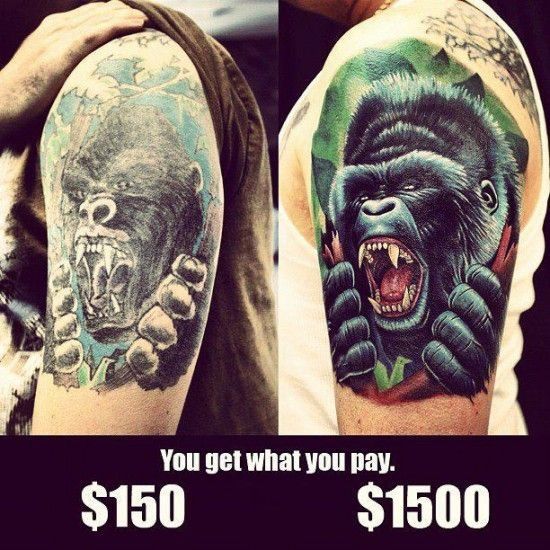
How shops actually charge
Three models, and most shops use all three depending on the job.
The shop minimum is the floor - the least the shop will accept for anyone sitting in the chair, whatever the size. It covers the needles, ink, tubes, gloves and the sterilisation that gets binned afterwards, plus the artist's setup and breakdown time. A postage-stamp design still costs the shop a full station. In most Western cities the minimum sits somewhere around $80-$150.
Hourly is the norm for anything mid-sized. The rate reflects demand and experience far more than cost of living: an apprentice and a fifteen-year artist in the same shop can be a hundred dollars an hour apart.
Day rate takes over on large work - sleeves, backs, ribs - and usually buys you six to eight hours at a discount on the hourly. It also means the artist has blocked out their whole day for you, which is why deposits are non-refundable and why cancelling late is genuinely costly to them.
What a range looks like
Rates move with city, artist demand and the style. Treat these as the shape of the market rather than a price list, and expect a busy artist in a major city to sit at the top of every row.
| Work | Typical size | Sittings | What it usually costs |
|---|---|---|---|
| Small linework or lettering | Under 3 in | 1 | Shop minimum, $80-$150 |
| Palm-sized black and grey | 3-5 in | 1 | $150-$400 |
| Forearm piece | 6-8 in | 1-2 | $400-$900 |
| Half sleeve | - | 3-5 | $1,200-$3,000 |
| Full sleeve | - | 6-12 | $2,500-$8,000 |
| Back piece | - | 10-25 | $5,000-$15,000+ |
What pushes a quote up
- Colour, and especially colour packing. Saturated colour takes multiple passes and is slower to lay in than black and grey.
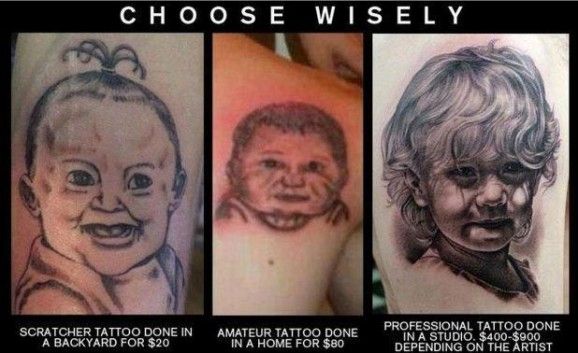
- Detail density. A portrait or a photorealistic animal is hours of concentration; a bold traditional design of the same size may be half the time.
- Placement. Ribs, sternum, hands, feet and the back of the knee take longer because the skin moves, stretches or objects, and the client needs more breaks.
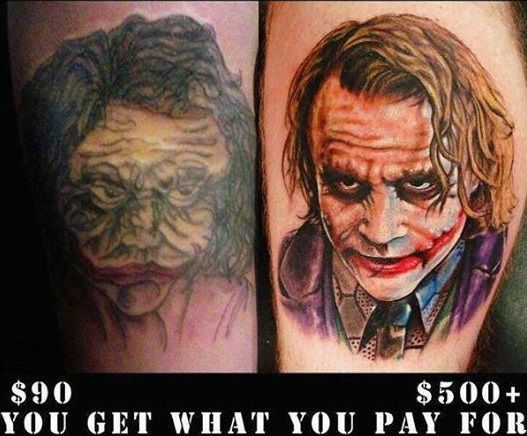
- Cover-ups, which need a bigger, darker design than the original and take planning time before the needle touches skin.
- Custom design time. Many artists draw on their own hours and price it into the tattoo. Some charge a separate design fee, deducted from the final cost. Ask which, so nothing surprises you.
Free consultations and the deposit are standard. The deposit - often the shop minimum - comes off the final bill and is forfeited if you no-show.
Why the cheapest quote is usually the expensive one
Laser removal costs several times what the tattoo did, hurts more, takes eight to twelve sessions spaced weeks apart, and does not always clear completely. A cover-up means living with something bigger and darker than you wanted. A bad tattoo is not a cheap tattoo - it is a deposit on a much larger bill.
The corollary matters too: if a good artist's quote is beyond you right now, the answer is to save, or to scale the design down, not to shop the price until someone says yes.
Tipping
Tipping is customary in the United States and Canada, uncommon in much of Europe and Asia, and never expected in Japan. Where it applies, 15-20% of the total is normal, and it is usual to tip at the end of a multi-session piece rather than every sitting. If you are unsure, ask the shop what is normal where you are - nobody will think less of you for it.
What to ask before you commit
- What is your hourly or day rate, and what is the shop minimum?
- Roughly how many sittings, and how long each?
- Is design time included, or charged separately?
- What is the deposit, and what happens if I need to reschedule?
- Is a touch-up included, and for how long afterwards?
Ask all five at the consultation. An artist worth booking answers them plainly, and will tell you if your budget does not match your idea - which is information worth more than a lower number.