The Greatest Tattoo Artists (Checked 2026)
This page was written in 2013 and has been checked in September 2026. A good deal has changed since, because the generation that made modern tattooing what it is has been retiring, and in some cases the shops that carried their names have closed with them.
That is worth reading as history rather than as a directory. Almost nobody on this page is taking new clients.
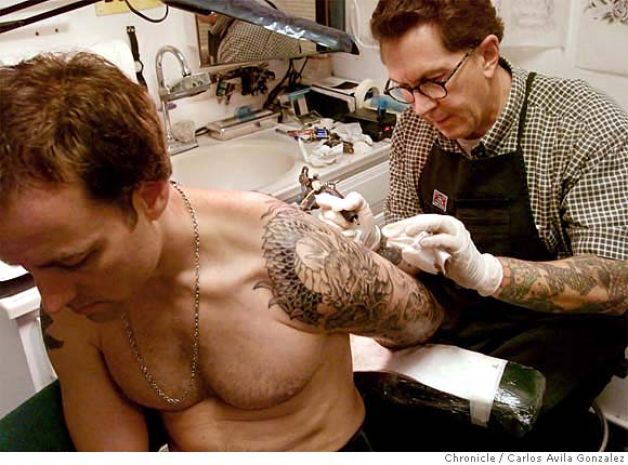
Don Ed Hardy
The single most consequential figure in Western tattooing, and the reason the craft looks the way it does now.
Hardy trained in fine art at the San Francisco Art Institute, then went to Japan in 1973 to apprentice under Horihide - the first Westerner to do so. What he brought back was not a style but an idea: that a tattoo could be a single composition designed for a whole body, the way Japanese work is, rather than a collection of separate images bought off a wall. He opened Realistic Tattoo in 1974 as a custom-only, appointment-only studio, which barely existed as a concept at the time, and Tattoo City in 1977.
Where he is now: Hardy retired from tattooing over a decade ago because of arthritis. Tattoo City in North Beach, San Francisco, run in later years by his wife Francesca Passalacqua and his son Doug Hardy, closed at the end of 2024. Hardy has been living with dementia.
The clothing brand that carries his name in shopping centres is a licensing deal and has almost nothing to do with the work. Look at the tattooing.
The old school
The generation Hardy learned from, and their reach is still visible in every traditional shop on earth.
Sailor Jerry (Norman Collins), Honolulu, who corresponded with Japanese masters, developed his own pigments, and set the visual grammar of American traditional tattooing. Died 1973.
Horihide (Kazuo Oguri), Gifu, who taught Hardy and opened Japanese tattooing to the West.
Lyle Tuttle, San Francisco, who tattooed Janis Joplin and, more than anyone, moved tattooing from the margins into ordinary visibility in the 1970s. Died 2019.
Bert Grimm, whose Long Beach shop ran for decades on the Pike and trained a long line of tattooers.
Cliff Raven, Chicago and Los Angeles, an early bridge between fine art training and tattooing.
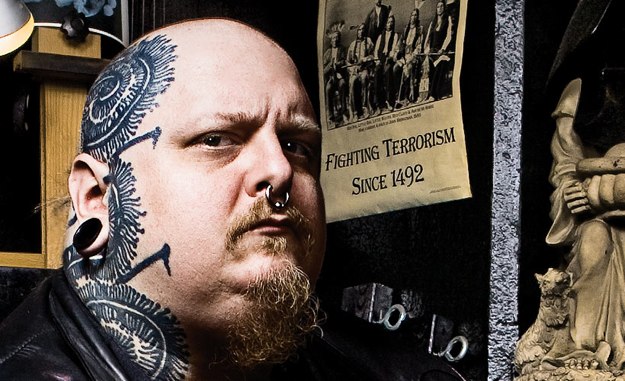
Paul Booth
The defining figure in dark surrealist black and grey. Booth opened Last Rites Tattoo Theatre in New York in 1996 and spent two decades building a style - heavily textured, morbid, closer to Beksinski than to any tattoo tradition - that a whole generation of black and grey artists worked from.
Where he is now: Last Rites closed in May 2020 under the economic pressure of the pandemic. Booth continues as an artist across tattooing, sculpture and painting.
Filip Leu
Born in Paris in 1967, taught by his parents Felix and Loretta from the age of eleven, tattooing professionally at fifteen. Leu is generally regarded as the finest large-scale tattooer working in the European tradition, and his back pieces and body suits are studied by artists who will never come close to them.
Where he is now: The Leu Family's Family Iron in Sainte Croix, Switzerland, running since 1978, with three generations of the family working. Still going.
Horiyoshi III (Yoshihito Nakano)
The most internationally documented living practitioner of Japanese irezumi, and the artist most responsible for the outside world understanding what traditional Japanese tattooing actually is - a full-body composition governed by rules about what pairs with what and how it sits on the body.
Where he is now: 80 years old, and in recent years concentrating on traditional silkscreen paintings mounted as kakejiku scrolls rather than on tattooing. His son Kazuyoshi Nakano received the Horiyoshi IV title in 2020 and is his sole active apprentice. The Horiyoshi III Tattoo Museum in Yokohama is open to visitors.
Guy Aitchison
One of the people who made biomechanical and abstract tattooing a serious proposition rather than a novelty, and, unusually, a prolific teacher - much of the technical writing that working tattooers learn from traces back to him.
Kat Von D
Included because she is the name most people outside tattooing know, and the history is worth stating accurately. High Voltage in West Hollywood ran from 2007 and closed on 1 December 2021; she moved to Indiana. Her significance is less about the tattooing than about LA Ink putting the process on television and bringing an enormous number of people into shops for the first time.
What this list is missing
Written in 2013, it is heavily weighted toward American men, and the craft is not. Tattooing right now is being pushed hardest by artists working in fine-line, ornamental, Chicano, Japanese and blackwork traditions across Asia, South America and Europe, a great many of them women, and most of them findable on Instagram rather than in a list like this.
If you want to see where the craft is going rather than where it came from, follow the conventions - Mondial du Tatouage in Paris, which Tin-Tin founded and which ran its final edition in early 2026, and the London, Milan and Tokyo shows - and look at who is guesting where.